We leverage SPADE to exhaust micro-motion information
Introduction
In the context of single-particle tracking, classical direct imaging is theoretically optimal in a noiseless universe; it reaches the quantum limit—imposed by the quantum Cramér-Rao bound—for tracking micro-motions.
However, real-world detection is inevitably plagued by noise. In practical scenarios, traditional imaging faces a critical limitation: distributing photons across many pixels severely reduces the photon counts per pixel, making the measurement highly sensitive to background noise.
Our work shows the possibility of overcoming this limitation. By utilizing two elaborately designed modes, we alleviate this inherent contradiction of direct imaging, allowing deterministic micro-motion parameter estimation to achieve near-optimal precision even under extreme noise conditions.
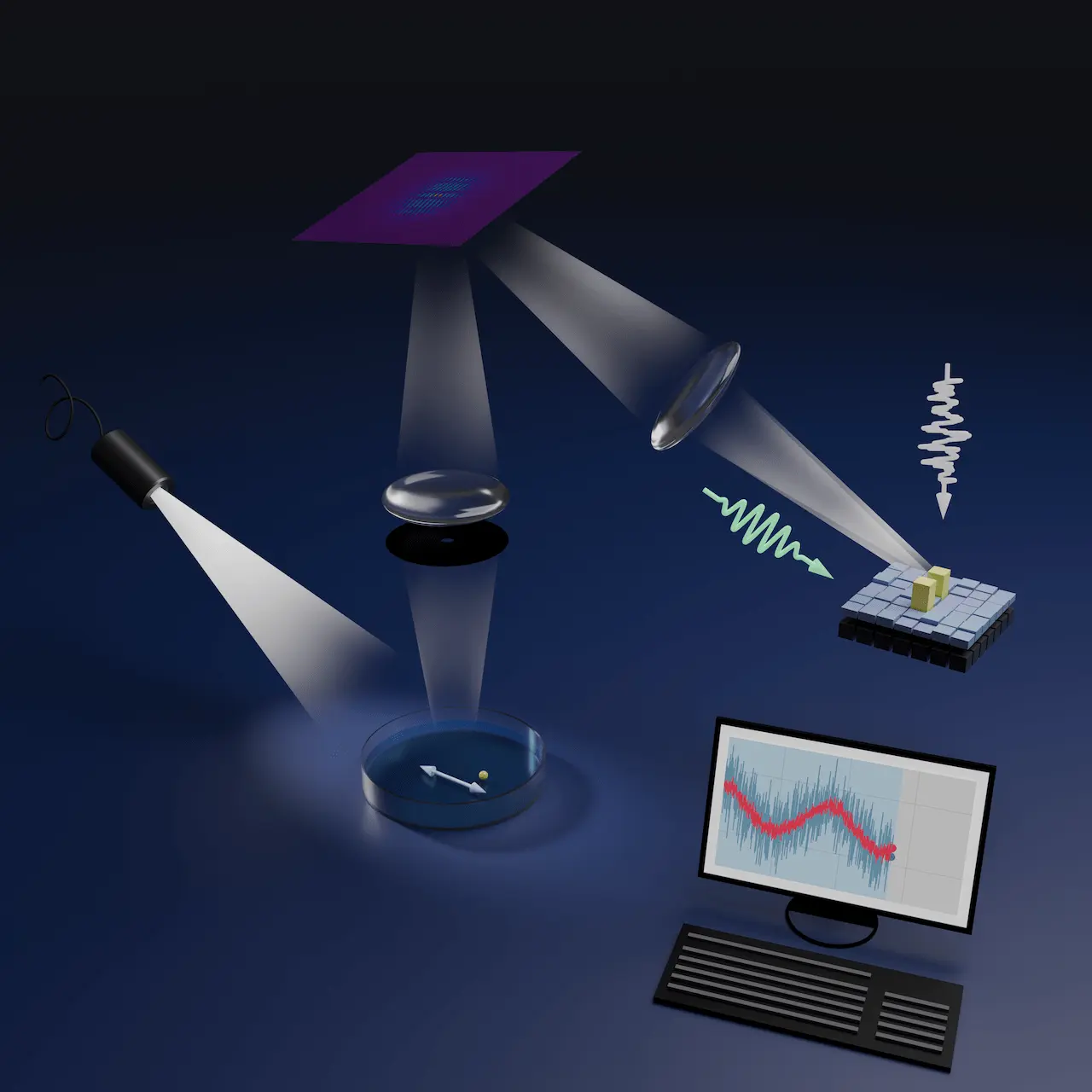
Artistic illustration for SPADE-based micro-motion detection.
Quantum parameter estimation
The theory of quantum parameter estimation was first pioneered by C. W. Helstrom. Just like classical estimation theory has the Cramér-Rao bound and classical Fisher information, Helstrom created their quantum versions: the quantum Cramér-Rao bound and quantum Fisher information. Later in 1994, S. L. Braunstein and C. M. Caves proved that quantum Fisher information is the maximum possible classical Fisher information you can get across all possible measurement methods. Together, these ideas build the basic framework of quantum parameter estimation.
Quantum Fisher information lives on the quantum state itself. It tells you the absolute maximum amount of parameter information hidden inside that state. On the other hand, classical Fisher information is based on probability distributions. It sets the ultimate limit on how small your estimation error can get, no matter what specific estimator you choose.
As quantum mechanics developed, quantum measurement became a core concept in quantum metrology. According to the Born rule, measurement outcomes always show up as probabilities. Hence, we can think of classical Fisher information as being defined directly by your chosen measurement setup. Once the quantum state is fixed and your measurement scheme is chosen, the classical Fisher information is determined, which can then be extracted by choosing an appropriate estimator.
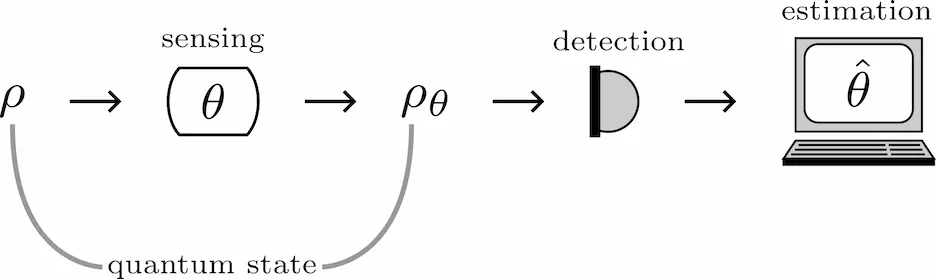
Quantum detection and estimation.
Spatial-mode demultiplexing
When it comes to resolving two incoherent point sources, traditional direct imaging has long been constrained by the Rayleigh limit. However, a breakthrough [Phys. Rev. X 6, 031033 (2016)] by Tsang et al. revealed that this limit is far from an absolute physical barrier. By demonstrating that the quantum Fisher information remains constant even as the source separation vanishes, they proved that the Rayleigh limit is not a fundamental limit of physics. This insight led them to propose spatial-mode demultiplexing (SPADE) as a measurement scheme.
From the perspective of quantum measurement, direct imaging projects the incoming light field onto a coordinate basis, i.e., spatial positions.
In contrast, SPADE expands the field into a set of orthogonal spatial modes
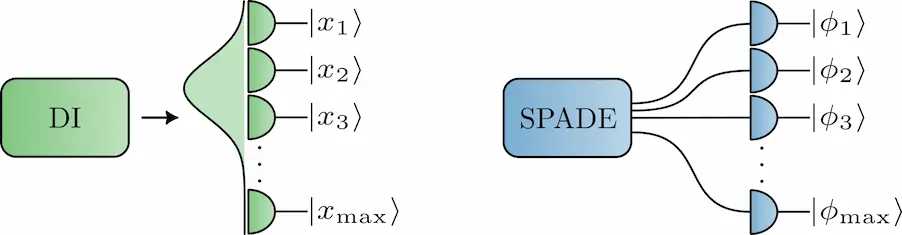
Schematic of direct imaging (DI) and SPADE.
Our work
SPADE has achieved remarkable success in the field of incoherent imaging by efficiently extracting spatial information. Naturally, this raises a question: can SPADE also benefit single-particle localization and tracking?
To explore this, our group’s prior research [Opt. Express 31, 19336 (2023)] proposed a set of superposition modes, termed “plus-minus modes”, to estimate the lateral displacement of a single point source, demonstrating the feasibility of SPADE in single-point localization.
In this work [Phys. Rev. Lett. 135, 243802 (2025)], we extend this framework from static localization to dynamic tracking. We demonstrate that our plus-minus mode-based SPADE (PM-SPADE) can achieve the ultimate quantum limit even in the presence of heavy background noise, requiring only that the point source does not undergo excessive motion—a condition inherent to micro-motion tracking.
We demonstrate that PM-SPADE outperforms direct imaging in estimating the micro-oscillation frequency of an optical point source under excess noise, with its advantage becoming more significant as the noise increases. These advantages suggest that SPADE holds promising potential for applications in fields such as biology and astrophysics.
More details
Let us consider an optical point source, or an illuminated particle, moving transversely from the optical axis in the object plane, with its motion described by
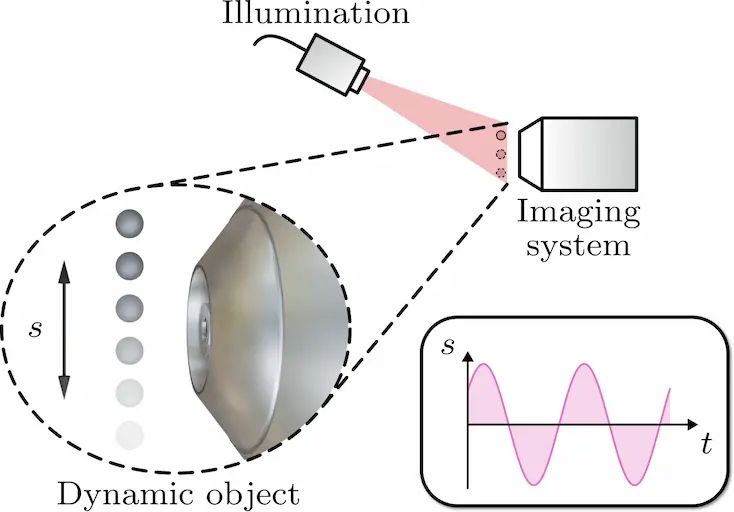
Illustration of the dynamic single point source.
We use quantum parameter estimation theory to evaluate a measurement strategy for estimating the motion vector parameters
and
where
We then verified our theoretical model with the following experimental setup: A continuous-wave (CW) Gaussian beam illuminates a digital micromirror device (DMD), imaged by a single-lens unit-magnification system; PM-SPADE is realized via digital holography with a phase-only spatial light modulator (SLM).
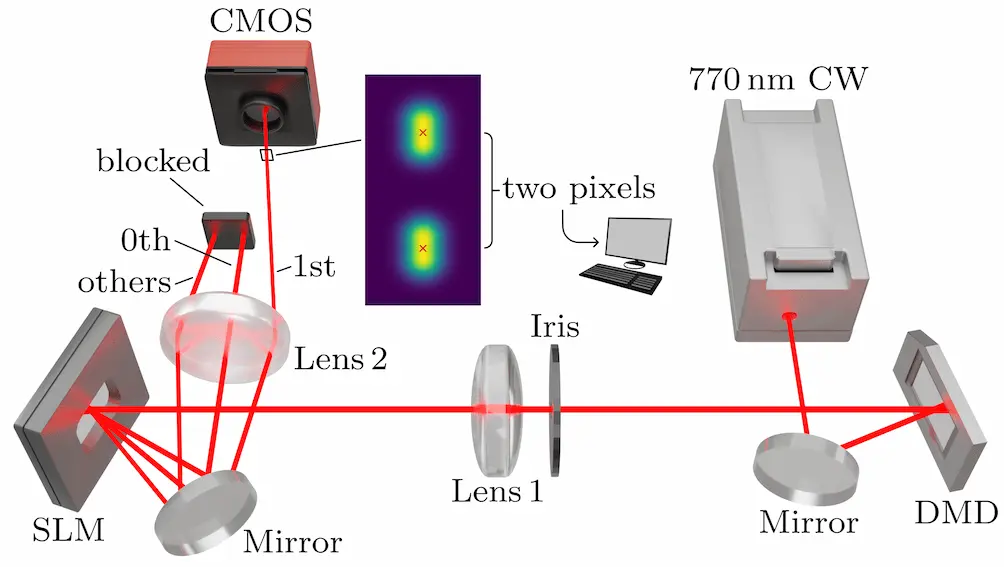
Experimental setup for PM-SPADE. Blender components pack by Ryo Mizuta Graphics.
The figure below presents the experimental results alongside our theoretical predictions. It shows the means and rescaled variances (which quantifies the estimation error) of the frequency estimates obtained through PM-SPADE and direct imaging as functions of the relative intensity of excess noise, which is uniform across all detectors. Here, CRB and QCRB denote the classical and quantum Cramér-Rao bounds, respectively.
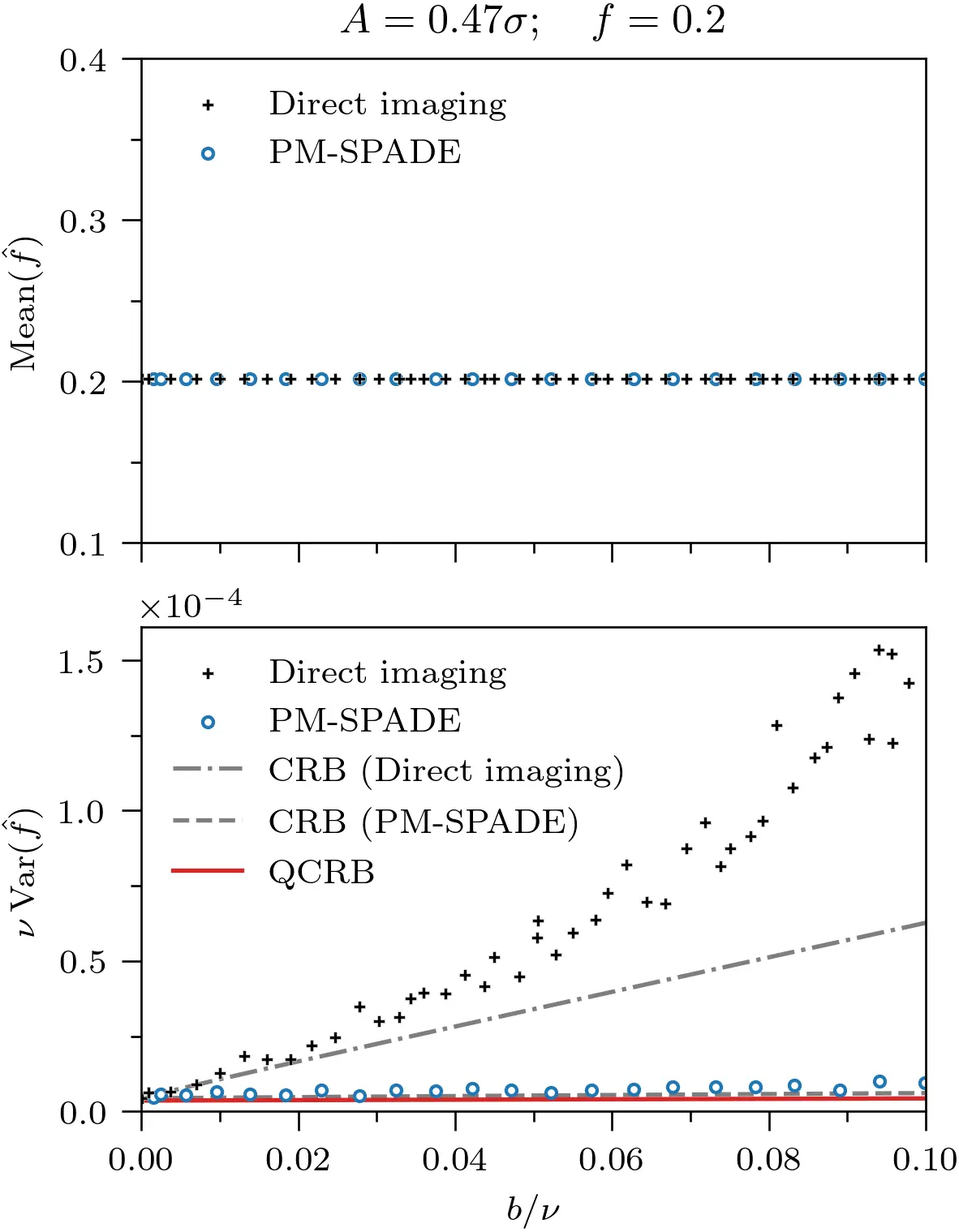
Mean and rescaled variance of PM-SPADE and direct imaging versus the noise induced by background light.
-
Paper information: Measuring the Oscillation Frequency beyond the Diffraction Limit, Phys. Rev. Lett. 135, 243802 (2025).
-
DOI: 10.1103/szcc-vk9r.
-
Read the full paper: arXiv:2504.04350.
Comments should be available here…
If it doesn’t work, you can view on GitHub Discussions.